This is a timesheet bill.
One project. One task. The more you invoice, the more they charge: $104 a month for two people to track their time.
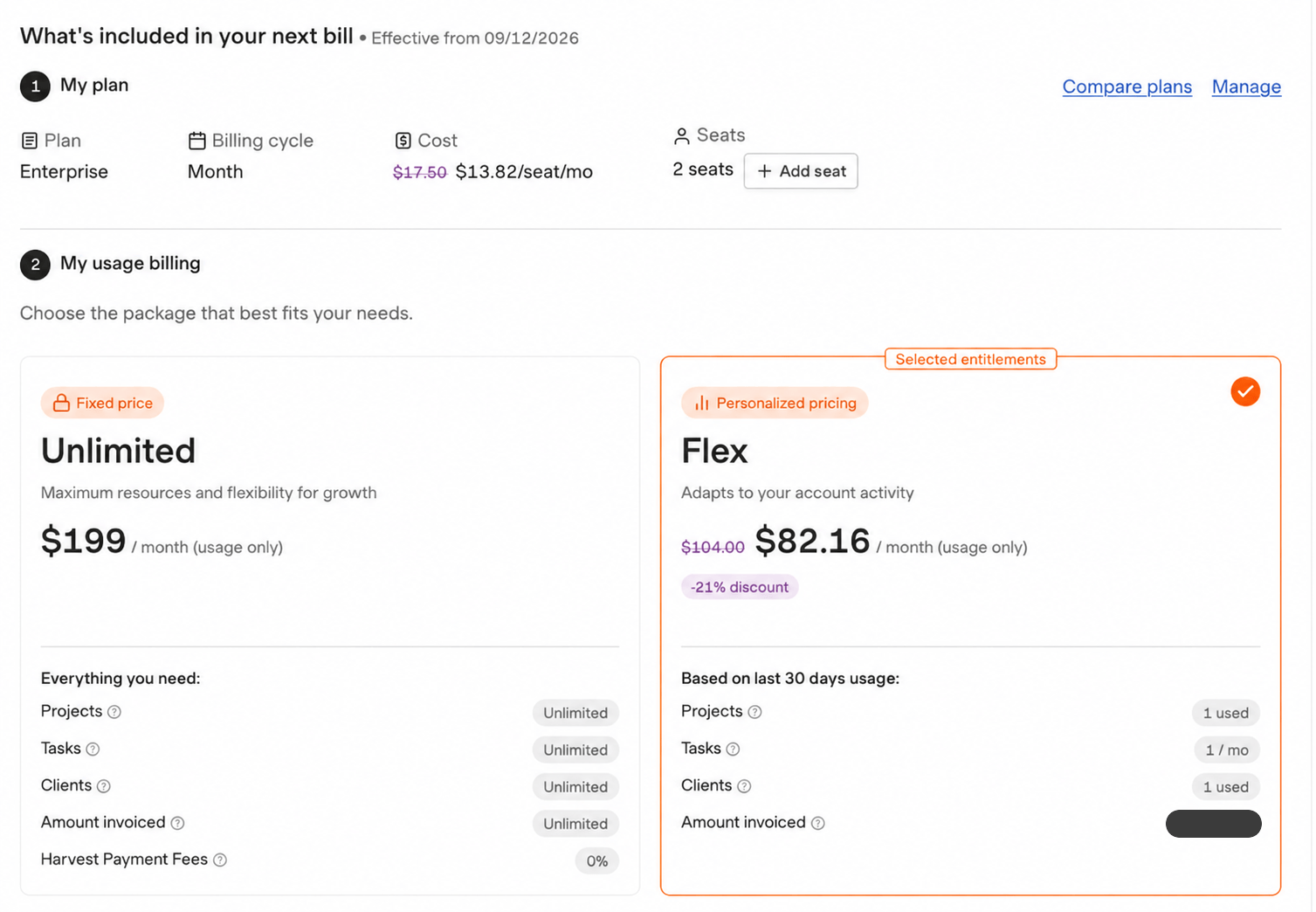
Look at what drives the $104. Projects, tasks and clients each carry a free allowance, and this account is inside all three. The entire charge comes from the last line: the amount invoiced. Harvest is not charging for resources used. It is charging a percentage of the business you did.
How the pricing works
Harvest bills a per-seat rate and then bills usage on top of it. The usage package is called Flex, and it meters five things at once: active projects, tasks, clients, invoices sent, and the amount you invoice. The first four carry small free allowances. The fifth does not.
The way out of Flex is Unlimited, at $199 a month on top of your seats. For two people that is about $221 a month to stop your bill from moving. Predictable pricing is the paid upgrade. Tally Whacker is $30.
What the invoiced-amount band costs
The measured rows are from my own account. The invoiced figure behind the $104 point is the redacted row above; the calculator uses it without printing it. Harvest does not publish the bands between the measured points, which is why every "Harvest alternatives" post hand-waves at usage fees. The calculator below interpolates them and marks the interpolation rather than pretending to know.
The story is the row you can't see. Somewhere past $20,000 a month in billings, the charge goes from $15 to $104 — about sevenfold, for doing more business.
What it would cost you
Tally Whacker would save you $1,104 a year.
At these numbers Harvest may be cheaper for you. Worth knowing before you move.
Our Harvest figure is an estimate — they don't publish multiplier rates.Check it against your bill.
Seven days free. No card. Two fields and an email link.
Harvest is offering accounts a loyalty discount of 21% off if they stay. Ask what your rate is when the promo ends.
Where these numbers come from
Harvest's usage charge is measured from real world experience: free under $3k a month invoiced, $15 from $3k to $20k, $650 at $200k and up, and $104 at one point in between, read off my own bill. That figure is the redacted row on the Harvest page; the calculator uses it without printing it. Between the measured points we interpolate, and this page says so when it does. The per seat rate is Harvest's cheaper Teams plan at $11. List prices throughout, not the temporary loyalty discount.
What you'd be moving to
$15 per person per month. One plan, nothing metered, no tier above it. Timesheets, dated bill rates, invoices and PDFs, recurring schedules, automatic overdue reminders, partial payments, AR aging, an audit log, two-factor. The whole list is on the homepage.
Whatever you decide, get your data out of Harvest before you cancel. Their free tier is one seat and two projects, and downgrading can lock you out of your own invoice history.